

Linear Guide Pairs - Operation and Maintenance Manual
2026-08-18
Applicable products: Series of ball linear guides, roller linear guides
Applicable scenarios: Automated equipment, CNC machine tools, precision mechanical equipment, heavy-duty equipment
Purpose of the document: Factory delivery, customer installation manual, equipment maintenance standards
I. Product Introduction
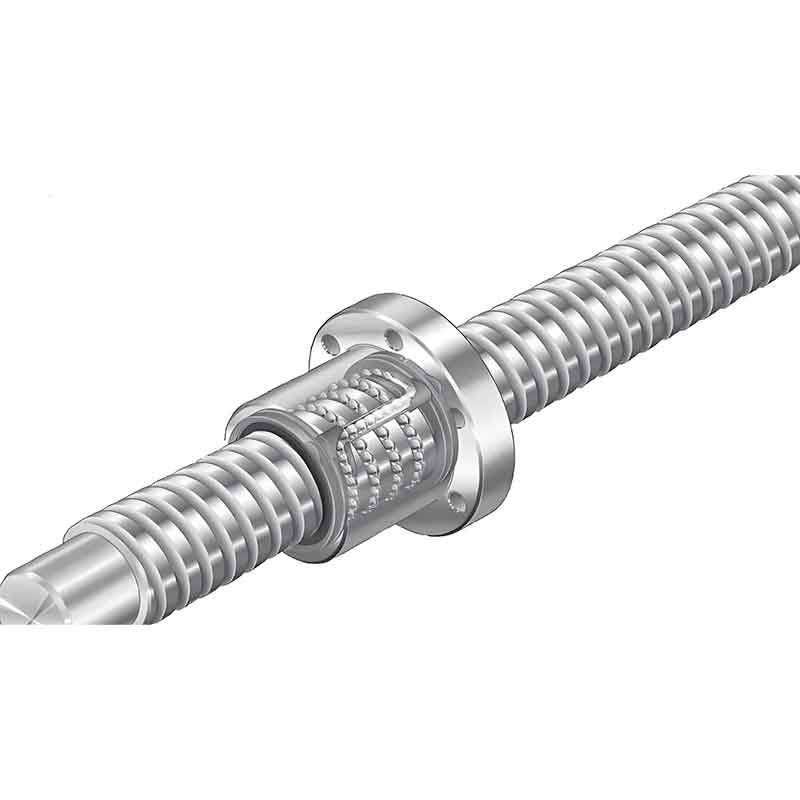
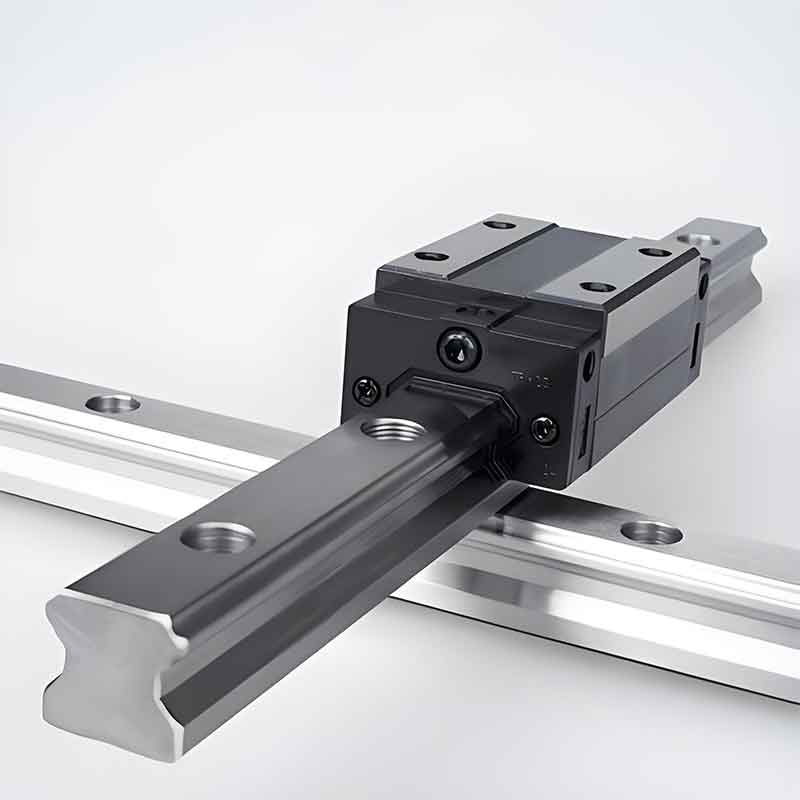
A linear guide pair consists of a guide, a carriage, circulating rolling elements, a cage and sealing elements. It provides high precision, low friction, high rigidity and long lasting linear reciprocating motion. Widely used in precision automation, CNC machine tools, gantry and heavy duty machining applications.
These products are made of high-carbon chromium bearing steel, have undergone general high-frequency hardening and precision grinding, and have high hardness, wear resistance, precision stability, vibration resistance and high load capacity.
II. Product technical parameters
1. Material: guide - S55C, carriage - 20CrMoA, high carbon chromium bearing steel;
2. Surface hardness: HRC 58–62;
3. Effective depth of hardened layer: ≥ 1.5 mm;
4. Roughness of working surfaces: raceway Ra 0.4 µm, mounting base surface Ra 1.6 µm;
5. Accuracy classes: class C (standard), class H (increased), class P (precision);
6. Preload levels: no preload, light preload, medium preload, heavy preload (selectable).
III. Important installation instructions
1. The mounting base surface should be smooth, free of burrs, protuberances and metal shavings. Insufficient accuracy of the base surface will directly lead to decreased guide accuracy, noise and accelerated wear.
2. Clean the guide, carriage and mounting surface before installation. It is prohibited to strike the guide body with hard objects, or to use brute force when disassembling/assembling the carriage.
3. The guide mounting screws are tightened evenly diagonally, applying force in stages to avoid deformation of the guide and accuracy deviation due to one-sided tightening.
4. When installing two or more guides, parallelism must be ensured. Forced tightening and forced straightening are prohibited to avoid jamming of the carriage and violation of the preload.
5. Do not disassemble the internal structure of the carriage yourself. This will result in rolling elements falling out, loss of accuracy and voiding the warranty.
6. When performing welding and grinding work, it is necessary to protect the guides from welding splashes and dust getting inside the carriage.
IV. Lubrication instructions (essential maintenance item)
1. Selection of lubricant
Lubrication (recommended for heavy loads, low speeds, dusty environments): NLGI 000 grade grease (brands: Mobil, Great Wall).
Oil (recommended for high speed and precision equipment): liquid oil grades 32, 46, 68 (preferably 46).
2. Application method by hand oil pump (standard procedure)
1. Clean the surface of the oil nipple on the carriage from dust, chips and dirt to prevent foreign particles from entering the oil channel.
2. Press the outlet of the manual oil pump firmly against the oil fitting of the carriage, ensuring a tight connection without leakage.
3. Press the pump handle evenly and slowly to dispense lubricant smoothly. Sharp and rapid pressing is prohibited.
4. Continue applying lubricant until lubricant begins to emerge evenly from the carriage gaps - this means that the internal oil channel is completely filled. Stop feeding immediately.
5. Wipe off excess grease from the oiler and the surface of the carriage. The procedure is completed.
6. Repeat the operation for each grease nipple on all equipment carriages.
3. Lubrication frequency
Continuous operation 24 hours: replenish lubricant every 80–100 hours.
8-hour workday: top up every 7-10 days.
Conditions with high levels of dust, humidity, shock and heavy loads: lubrication intervals are reduced by 50%.
After a long period of inactivity: before starting, it is necessary to add lubricant and idle for 2 minutes without load.
V. Dust protection and daily maintenance
Keep the guide surface clean daily to prevent the accumulation of chips, dust and oil deposits.
In harsh operating conditions, be sure to install protective covers and telescopic covers (accordions) to prevent contaminants from entering the carriage, which can cause wear and binding.
It is prohibited to store the guides open for a long time due to corrosion, accumulation of moisture and dirt.
If the equipment is idle for more than 7 days, it is necessary to add lubricant in advance and manually run the carriage to prevent dry friction and corrosion.
VI. Typical faults and troubleshooting methods
| Malfunction | Possible reasons | Elimination method |
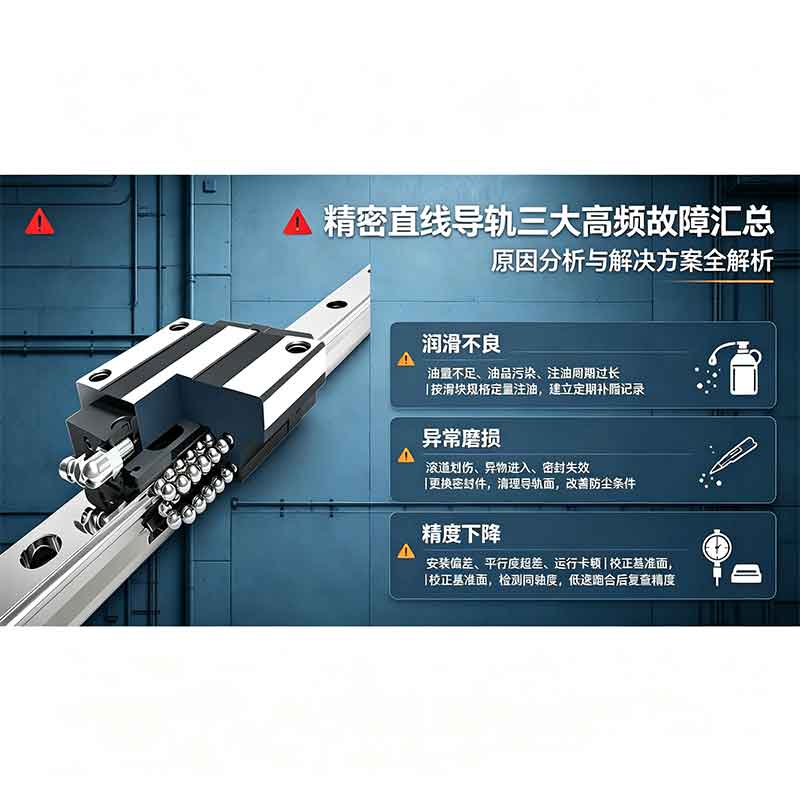
| Extraneous noise, grinding noise during operation | Lack of lubrication, dust ingress, insufficient lubrication | Clean, re-lubricate, check seals |
| Sticking, increased resistance to movement | Deformation during installation, excessive preload, foreign object penetration | Checking parallelism of installation, adding lubricant, removing foreign objects |
| Reduced accuracy, positioning deviation | Uneven base surface, prolonged wear, running without lubrication | Re-check installation accuracy, maintain lubrication, replace worn parts |
| Excessive squeezing of lubricant from the carriage | Excessive amount of lubricant, high supply pressure | Removing excess lubricant, reducing the volume of one-time supply |
VII. Prohibited actions
1. Do not hit, drop or bend the guides.
2. Self-disassembly of the carriage, cage and rolling elements is prohibited.
3. Working without lubrication and dry friction is prohibited.
4. Mixing lubricants/oils of different brands and types is prohibited.
5. It is prohibited to operate without protection in conditions of intense dust and abundant formation of chips.
VIII. Instructions for storage and transportation
1. Products are coated with anti-corrosion oil and protective film from the factory. If the packaging is opened but the product has not been used, the anti-corrosion protection must be reapplied.
2. Storage conditions: dry, ventilated room without aggressive gases. Long-term storage in damp conditions is prohibited.
3. During transportation, heavy pressure, falling and squeezing are prohibited to avoid deformation of the guides and loss of precision.