
Three Most Common Precision Linear Guide Failures - Full Cause and Solutions Analysis
2026-08-04
With the accelerated modernization of automated equipment, CNC machines, semiconductor and power plants, the application of precision linear guides as key drive components is constantly expanding. Under conditions of long-term serial operation, guides often develop defects such as dents on the raceways, balls falling out and cracks on the end covers and sealing elements. These faults not only reduce the positioning accuracy of the equipment, but also significantly reduce the overall service life of the machine.
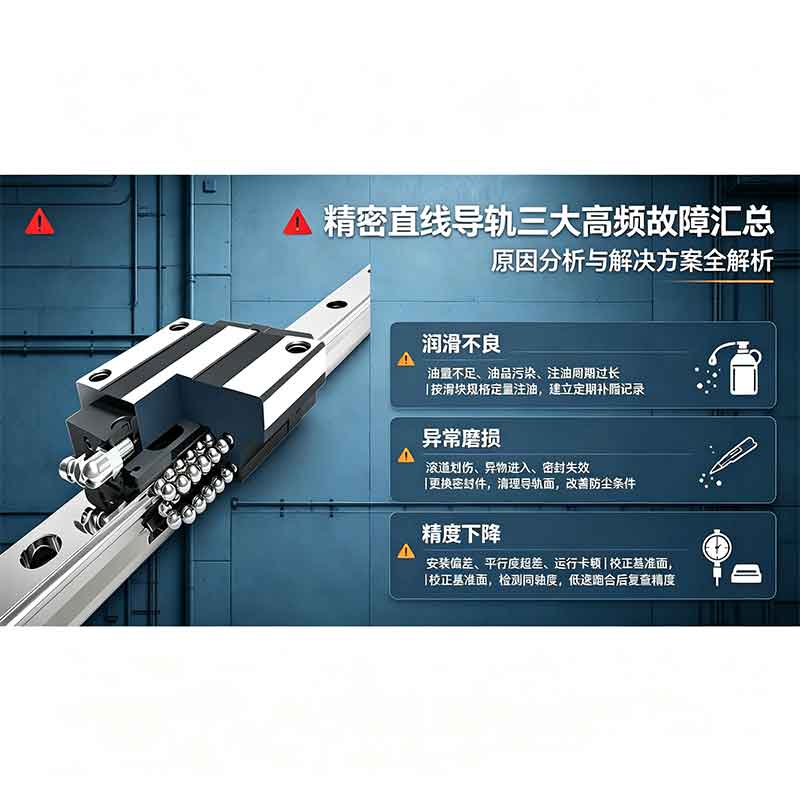
Based on years of after-sales service experience and real-world testing data, CRK has summarized the three most common types of guide faults, identified their root causes, and developed standardized solutions and preventive measures. This material will help equipment manufacturers and repair personnel quickly diagnose faults and extend the service life of guides.
I. Malfunction: Constant dents on the raceways, cracking and destruction of the balls inside the carriage
Causes:
Overload and eccentric loading: The actual load and dynamic shock forces exceed the static and dynamic load ratings of the carriage. The balls exceed the permissible load limits, plastic deformation occurs, dents appear on the raceways and the balls are destroyed. Unilateral loading and excessive overturning moments further increase local stress concentration.
Lack of lubrication or incorrect choice of lubricant: Insufficient lubrication, too long intervals between lubrication, the use of incompatible or low-quality lubricants lead to the absence of a stable oil film between the raceway and the balls, the occurrence of dry friction and accelerated fatigue failure of the metal.
Dust and metal shavings entering the carriage: Chips and dust generated during processing penetrate through the sealing gaps into the circulation channels. Solid particles get stuck between the track and the balls, causing dents during prolonged rolling.
Solutions:
Optimization of the choice of standard size: Replacing with a guide of a larger standard size (for example, from the 20th to the 25th standard size) or increasing the number of carriages to distribute the load; adjustment of the installation structure of equipment to eliminate one-sided loading.
Rationing of lubricants: Replacement with specialized high-performance lubricant for guides, increasing the volume of one-time lubricant supply, reducing service intervals; installation of an automatic centralized lubrication system.
Strengthening protection against contamination: Installation of thickened two-lip sealing end caps, installation of external telescopic protective covers and metal chip collectors, regular cleaning of the surface of the guides from contamination.
II. Malfunction: Balls fall out and the circulation system is destroyed during carriage operation
Causes:
Long-term overload and high-frequency shock loads lead to fatigue failure of the balls and cage.
Chips entering the circulation channels scratch the balls, causing them to wear out and fail.
Failure to maintain the flatness of the mounting surface and the parallelism of the guides leads to the emergence of a constant lateral moment during operation, an imbalance of forces inside the carriage, deformation and destruction of the cage, as a result of which the balls lose their restraint and fall out.
Insufficient lubrication accelerates rolling wear, pitting corrosion and peeling appear on the surface of the balls, causing the balls to leave the circulation circuit.
Solutions:
Re-calculation of loads on equipment, reduction of shock loads, selection of guides with the appropriate level of preload.
Re-calibration of the mounting bases, checking the parallelism of the guides using a dial indicator, tightening the bolts diagonally with a standardized torque, eliminating forced assembly.
Periodic disassembly and cleaning of the carriage, replacement of worn separators, ensuring full cyclic lubrication at all stages of operation.
III. Fault: Deformation, cracking and destruction of the end caps and sealing elements of the carriage
Causes:
Violation of installation technology: After installing the guide, a one-sided load occurs, the carriage body is constantly subjected to shear stress, plastic end caps and sealing plates are destroyed over time from fatigue. External shocks during transportation and adjustment of equipment can also damage the sealing elements.
Exposure to aggressive environments and clogging: The ingress of dust and coolant, as well as drying and clumping of the lubricant, lead to blockage of the ball return channels, a sharp increase in movement resistance and deformation of the end caps under pressure.
Exposure to high temperatures and mildly aggressive environments: Under such conditions, standard plastic sealing elements are subject to aging and embrittlement, and their wear resistance is significantly reduced.
Solutions:
Installation must be carried out by qualified specialists with calibration of the mounting bases, excluding forced pressing of the carriage; When transporting equipment, provide protection from external shocks.
Installation of reinforced double-layer sealing kits with increased corrosion resistance, adapted for dusty and humid production environments; the use of specialized lubricants for high and low temperature conditions with increasing lubrication frequency.
Regular monitoring of the condition of end caps and sealing plates, timely replacement when the smallest cracks are detected to prevent secondary penetration of contaminants into the carriage.